
Return on Human.
Are We Fuel for the Machine or Do We Have a Hand on the Lever?

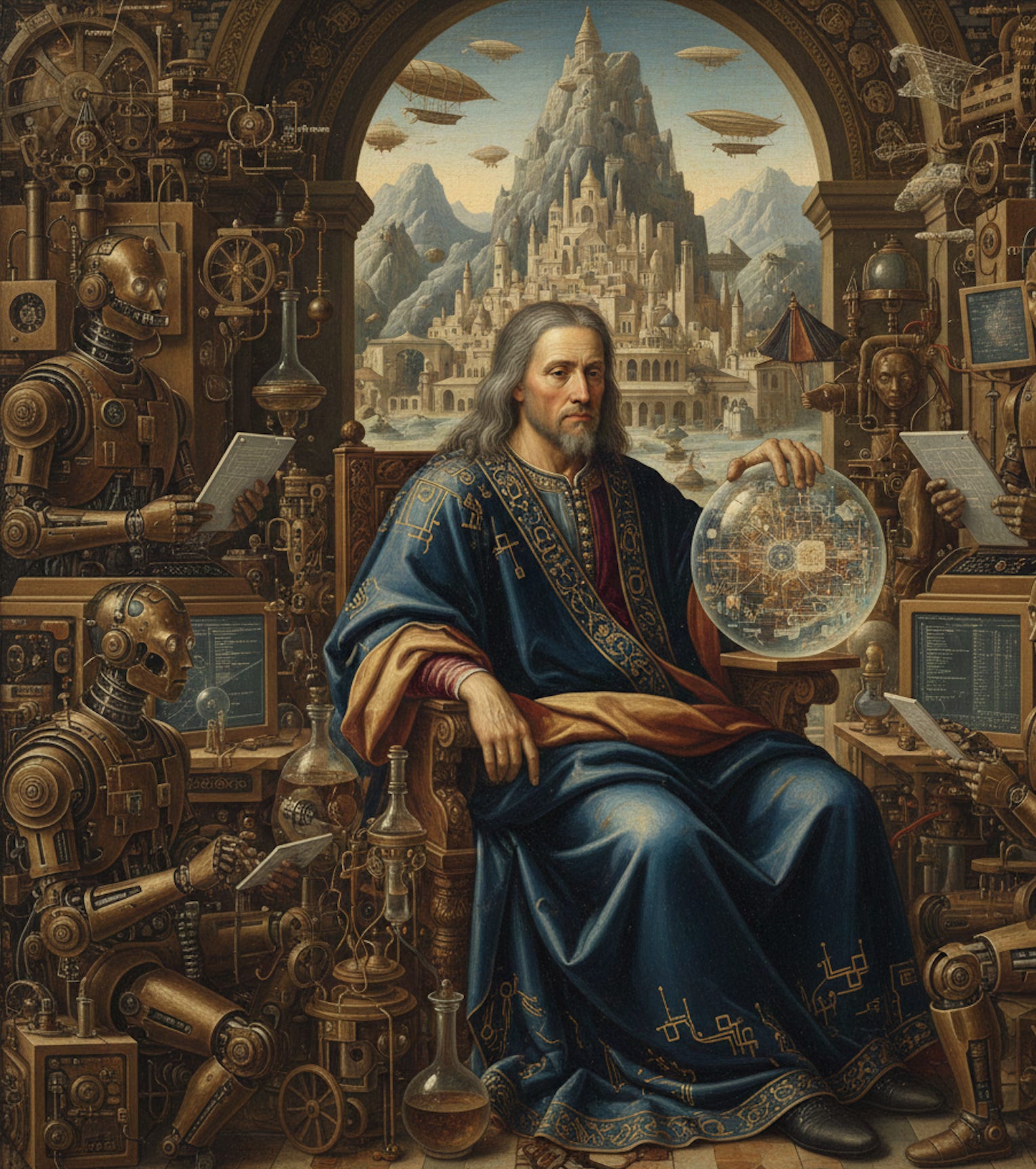
We’ve used headcount as a proxy for success. In the industrial and early digital eras, revenue and headcount were inextricably coupled: if you wanted to double your impact, you generally had to double your office space. We believed that bigger is better, but the data suggests we were looking at the wrong variable. We are now witnessing a structural decoupling of labor from output: a shift that allows a solo founder to leverage a Return on Human (ROH) that approaches infinity.
From the Grain to the Sea
This isn’t the first time technology has shattered our assumptions about how many people it takes to change the world. History is a record of the lever making the many into a few for the sake of the more.
Physical Levers: The End of Manual Drudgery
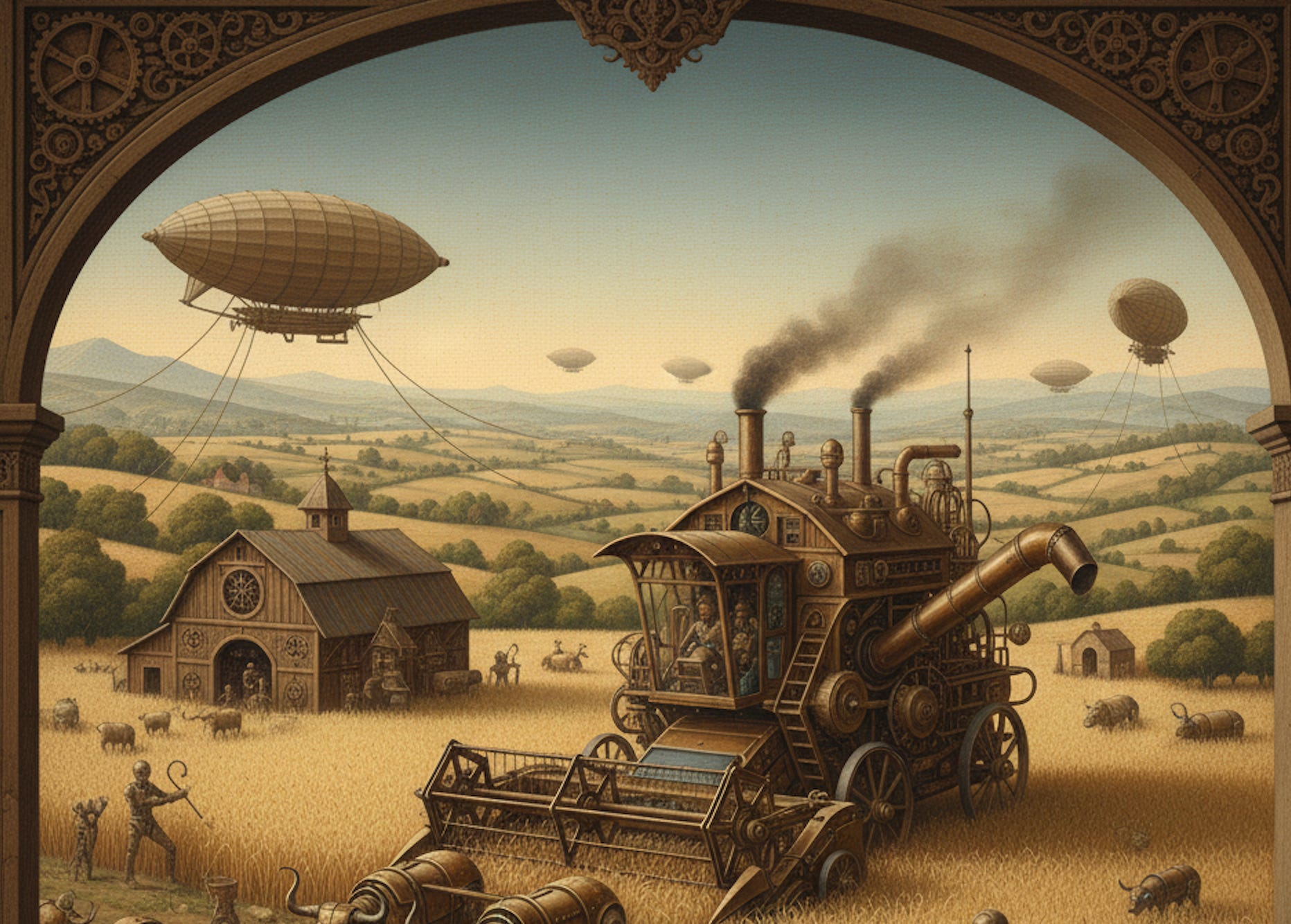
The Combine Harvester: In the 19th century, harvesting was a grueling process requiring a small army of laborers. By the 1940s, self-propelled combines drastically reduced manual reliance. Between 1948 and 2017, U.S. agricultural output tripled even as labor hours-worked declined by over 80%. We didn’t lose the farm; we lost the friction.
Maritime Automation: For centuries, ships were powered by hundreds of sailors struggling with manual sails. Today, automation and computer-assisted navigation have shrunk the largest, heaviest ships’ standard crew sizes from 50+ in the 1970s down to 15-21 today.
Intellectual Levers: The Decoupling of Thought from Output
The Printing Press: Before Gutenberg, a single book could take a scribe a year or more to produce by hand. A single Renaissance printing press could produce 3,600 pages per workday, compared to just a few by hand-copying. The intellectual labor was decoupled from the pen. While the scribes’ guild of Paris successfully lobbied to delay the press for 20 years out of fear of displacement, the technology eventually gave rise to thousands of new jobs in a massive new publishing industry.
The Electronic Spreadsheet: Before VisiCalc (1979), a spreadsheet was a physical sheet of paper, and a single what-if question required days of manual recalculation. Digital spreadsheets laid waste to an entire industry of cognitive labor. Since 1980, hundreds of thousands of accounting clerk positions have disappeared, but millions of accounting positions were created. The machine took the arithmetic; the human took the strategy. The output is more than 1.0x per individual accountant, even with more of them.
All these systems require some humans in the loop, but ultimately, capitalism requires an ever-increasing Return on Human (ROH).
Why This Time Is Actually Different
Every technological revolution prompts the same debate: “This time is different” versus “We’ve heard this before.” The skeptics have a point: combines and spreadsheets didn’t eliminate human work; they transformed it. But AI agents represent something fundamentally new: universal cognitive leverage.
The combine automated physical repetition in a single domain. The spreadsheet automated numerical calculation in another. AI agents automate reasoning itself across virtually every knowledge domain simultaneously. This isn’t domain-specific automation; it’s the automation of automation.
The difference is scale and scope. When spreadsheets emerged, accountants had to learn one new tool. When AI agents emerge, every knowledge worker must reconceptualize what doing work means. The spreadsheet made you faster at your job. AI agents make you question whether your job is doing or directing.
This creates a new imperative: organizations must decide whether they’re using AI to make their existing workers 20% more efficient (incremental) or to fundamentally restructure what a worker is responsible for (transformational). The former is augmentation. The latter is orchestration.
The Decoupling Ladder: From Augmentation to Orchestration
The path from individual contributor to orchestrator isn’t a single leap : it’s a series of capability jumps, each requiring a different mental model of what work means.
Stage 1: The Human (Unaided Baseline)
Revenue Per Employee: $250,000
The Reality: This is the traditional knowledge worker : writing reports, analyzing data, managing projects, attending meetings. Every output requires direct human effort.
Stage 2: The Augmentation (AI-Assisted, Today)
Revenue Per Employee: $625,000 (2.5x multiplier)
The Reality: AI acts as a tireless assistant : drafting emails, summarizing documents, generating first-pass code. The human still reviews, edits, and approves every output.
Diagnostic Question: Are you still approving AI outputs line-by-line, or have you built evaluation systems that can validate entire categories of work?
Most organizations are stuck here, treating AI as a faster intern rather than reconceptualizing the work itself.
Stage 3: The Manager (Agentic Workflows)
Revenue Per Employee: $4,200,000 (16.8x multiplier)
The Reality: The human designs systems where AI agents execute complete workflows autonomously : customer onboarding, data pipeline management, content distribution. The human intervenes only at decision points and exceptions.
Diagnostic Question: Can your agentic workflows operate asynchronously while you sleep, or do they still require your real-time supervision?
Sample: A compliance consultancy replaced the document review team with an agentic workflow: AI agents scan regulatory updates, cross-reference client portfolios, flag conflicts, and draft advisory memos. The founder reviews 50 recommendations weekly instead of producing 5 manually. Revenue per employee jumped from $400K to $3.2M in 18 months. Humanity check: what of the document review team?
This is where the “internal founder” emerges: someone who builds and manages portfolios of automated processes rather than performing tasks directly.
Stage 4: The Executive (Autonomous Swarms)
Revenue Per Employee: $42,000,000 (168x multiplier)
The Reality: Multiple agent teams coordinate with each other. The human sets strategic parameters and resolves conflicts between autonomous systems. Think of it as managing managers : each manager is a swarm of agents handling an entire business function.
Diagnostic Question: Do you own your inference infrastructure, or are you renting cognitive capacity from platforms that could change terms, raise prices, or mine your strategic insights?
This is where digital sharecropping becomes a critical risk. Without sovereignty over your AI capabilities, you are building on rented land.
Stage 5: The Unicorn (Pure Orchestration)
Revenue Per Employee: $1,000,000,000 (4,000x multiplier)
The Reality: The human is pure strategic vision and judgment. Execution is fully autonomous. This stage may not exist yet in its pure form, but companies like Midjourney (150 employees, $500M+ revenue) are demonstrating early versions.
Diagnostic Question: Are you the architect of the system, or has the system made you unnecessary?
The paradox: at this stage, the human is simultaneously more essential (irreplaceable judgment) and more precarious (easy to extract once the systems are built).
The Myth of the Soloist
Before we celebrate the one-person billion-dollar company, we need to acknowledge the invisible labor. Every soloist depends on:
Cloud infrastructure teams (AWS, Google Cloud, etc) maintaining the compute that runs their agents
API providers (Anthropic, OpenAI) training and serving the foundational models
Moderation and safety teams handling the content their systems produce at scale
Financial and legal infrastructure processing payments and managing regulatory compliance
The question isn’t whether you need other humans: it’s whether those humans are on your payroll or embedded in the platforms you rent. The soloist is less alone and more the architect who decides which infrastructure to leverage. Just like there are no true self made billionaires, it’s a network of climbs and discovery to one billion.
This matters because it determines who captures value. A soloist who builds on fully rented infrastructure is vulnerable to platform lock-in, price increases, and terms-of-service changes. True leverage requires ownership of your critical paths: whether that’s your training data, your fine-tuned models, or your orchestration logic.
The Human-Centric Moat: Vision, Storytelling, and The Irreducible Floor.
In an era where execution is a commodity, the primary moats have shifted to attributes that are irreplaceably human.
1. Vision as Strategic Architecture
AI is adept at detecting patterns, but it lacks the ability to interpret complex social nuances and organizational culture. A solo founder’s vision acts as a common sense check on statistically sound but strategically flawed algorithmic conclusions. The greatest edge is Double Literacy: the ability to be fluent in the language of technology and humanity.
2. Storytelling: The Architecture of Belief
When technology is democratized, emotion becomes the edge. Storytelling translates raw data into meaning and converts analytics into a narrative that investors and partners can believe in. Authentic, emotionally intelligent narratives cut through the polish of AI-generated content. (Total aside: I always thought film movies are more pleasant to watch and connected to the way we make memories because of the grain…)
3. The Irreducible Human Floor
There is a hard stop where trust, liability, and chaos require a human in the loop. A machine can draft a contract, but it cannot go to jail for fraud. High emotional intelligence is the primary driver of psychological safety, an atmosphere of trust essential for leading modular, fractional teams.
The Relocation of Brilliance : Why AI Makes us Work Harder.
We were promised that AI would give us back our time, but research from Harvard Business Review suggests it is actually intensifying work. AI accelerates tasks, which raises expectations for speed, making workers more reliant on AI and widening the scope of what they attempt.
Ambient Work: Work seeps into breaks and evenings because AI interactions feel conversational. The boundary between working and thinking about work dissolves when your assistant is always available and always willing.
The Reallocation of Brilliance: When the box of a job is automated, the human is freed to do more. Consider a master woodworker: once boxed into manual farm labor, they are now freed to build a business around specialized craft or automotive restoration. They are no longer a mechanic by necessity, but a specialist by choice, and both businesses flourish.
But here’s the trap: if freed to do more just means expected to do more, we haven’t created leverage: we have just created a hamster wheel that spins faster.
Bio HR: Surviving the Ultimate Plateau

A billion-dollar soloist faces the Ultimate Plateau: an intensity of work that is unsustainable without a new framework. This is the era of Bio HR.
AI reduces the need for coworkers, but it does not reduce the need for cortisol management. The solo founder must treat their biology as critical infrastructure. Bio HR frames personal well-being as a double bottom line, protecting the founder from the quiet cracking of burnout while they orchestrate their digital swarms.
Health is a structural necessity. At Stage 4 and Stage 5, you are the single point of failure. There’s no team to cover when you’re exhausted, no cofounder to share the cognitive load. Your capacity for judgment is the constraint. If you burn out, the entire enterprise stops.
Bio HR means:
Energy budgeting: Treating decision-making capacity as a finite resource that must be allocated strategically
Metabolic optimization: Sleep, nutrition, and exercise aren’t “nice to have” : they’re operational requirements
Cognitive recovery protocols: Deliberate practices for preventing decision fatigue and maintaining judgment quality
Emotional regulation systems: Managing the psychological toll of being perpetually on without peer support
The irony: as organizational friction approaches zero, the human becomes the bottleneck. Bio HR is how you prevent yourself from becoming the constraint that kills your own leverage.
Valuation and Efficiency Ratios
Investors now rotate toward quality and cash generation. A solo founder with an ARR-per-employee metric over $1.5M is viewed as a High Growth Leader and can command valuation multiples 4.7x higher than slow-growth, human-intensive peers.
Startup Median Multiples: 5.1x Revenue
AI-Native Outliers (Cursor, Midjourney): 25x–500x Revenue
These aren’t aspirational numbers: they are observable market behavior. Capital is repricing organizational efficiency in real time.
The Signal: The Rise of the Internal Founder
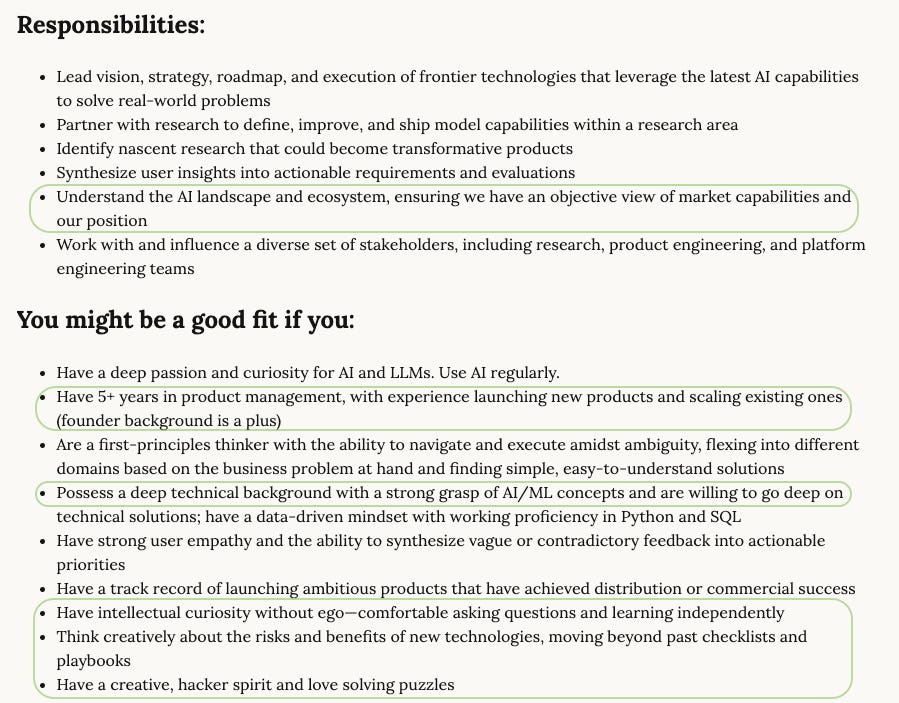
The market is already reacting. Anthropic is hiring Product Managers for research teams who are essentially internal founders. These roles focus on 0-to-1 product development, building MVPs with the lowest cost possible and identifying nascent research to define entirely new product categories.
This is the blueprint for the future: a soloist, with resourcing, acting as the node of vision within a larger ecosystem.
This isn’t a traditional PM role: it’s a founder role with institutional backing. Anthropic is betting that the future of product development isn’t 50-person teams; it’s high-agency individuals with leverage.
Conclusion: The Conductor of the Invisible Orchestra
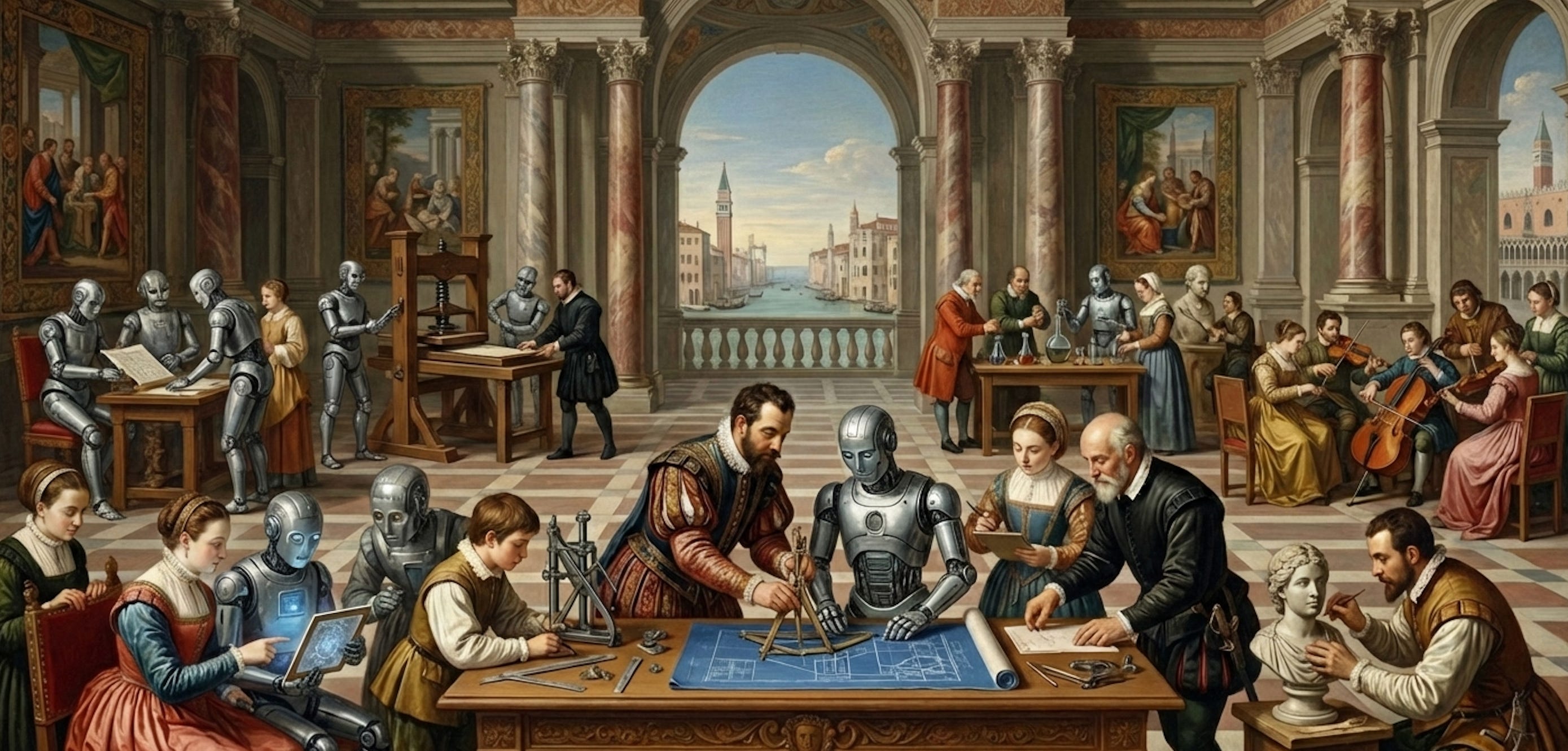
The $1 billion one-person company isn’t achieved by working a billion times harder. It’s achieved by driving the cost of execution toward zero while standing firmly on the irreducible human floor of judgment.
They are a conductor of an invisible orchestra. Like the farmer with the combine, they use technology to move from the work of doing to the work of deciding. But unlike the farmer, they face a uniquely modern challenge: the tools that give them leverage also threaten to consume them.
The future belongs to those who can master Bio HR to ensure that their humanity remains the driver, not the fuel, of the machine. Because at the end of the decoupling ladder, the only question that matters is the one in the title:
Are we fuel for the machine, or do we have a hand on the lever?
The companies hiring internal founders have already answered. The solo founders building AI-native businesses have already answered. The only question is whether the rest of us will recognize the shift before we’re left behind.
Addendum:
On Human Agency vs. Human Extraction
I want to be very clear that a pro-human world is the future. Much of the discussion is about how to work in a synergistic way with AI, but also to understand how AI + Human is being discussed by everyone from billionaires to working-class laborers.
Pure capitalism absolutely needs people on the top and people at the bottom, but in reality, one can argue it doesn’t need people in the middle. Hence why comments float around about UBI and so forth. But my take: You have a lifetime of context, creativity, and “human-ness” that no amount of processing power can perfectly replicate. You are more adaptable than you give yourself credit for.

Notes:
1. From “Cost Per Head” to “Owner of the Node”
In the traditional 200-person startup, the individual is often treated as a “Cost Per Head”: an expense to be managed, optimized, or eventually cut. In that model, the worker is a cog in a larger machine they don’t own.
The Soloist model flips this: the human is no longer the input (the labor), they are the architect (the owner). ROH isn’t measuring how much a company can squeeze out of a person; it’s measuring how much leverage an individual can exert on the world using digital swarms. It isn’t a single metric, but measurement does play a factor in understanding your position on the ladder.
2. Enabling vs. Coercive Structures
As organizational psychologist Adam Grant points out, the goal of a healthy hierarchy should be enabling, as opposed to coercive. The Return on Human concept is intended to track the agentic leap: where a human moves from performing routine, soul-crushing tasks (which is a form of modern drudgery) to directing portfolios of machines.
When a master woodworker uses AI to handle logistics, marketing, and accounting, he isn’t being extracted; he is being liberated from the box of a traditional job.
3. The Risk of Digital Sharecropping
This is a very real danger if the solo founder doesn’t own their tools. Research into the Mediocrity Trap warns that if you feed all your brilliance into a third-party AI, you are essentially training your own replacement. Without corporate sovereignty and private AI capabilities, the solo artist risks becoming a digital sharecropper: doing the hard work of vision while the platform captures all the value.
4. The Bio HR Accountability
The work intensification found in recent studies : where AI makes people work harder and faster rather than giving them time back is the true dystopian threat. This is why the concept of Bio HR is vital.
If ROH is pursued without regard for the human floor, it becomes a hamster wheel of cognitive fatigue. A true soloist must prioritize their own well-being over short-term efficiency to ensure that technology serves humanity, rather than the other way around.
In short: ROH is meant to measure human agency, not human extraction. It’s the difference between being the fuel for a machine and being the person with their hand on the lever.
Are we now witnessing a structural decoupling of labor from output? A shift that allows a solo founder to leverage a Return on Human (ROH) that approaches infinity?