
The Entropy Tax
Value, velocity, and what the economy is actually for. A single essay in three movements.

MOVEMENT I
The Banana Problem
In which money reveals itself
There is a banana at the grocery store near my house. It costs a dollar. Twenty years ago it cost a dime. Fifty years ago, a penny. The banana has not changed. But the number attached to it has drifted steadily upward, and we have collectively agreed to call this drift normal.
We call it inflation. We measure it, model it, target it at two percent annually like some kind of civic sacrament. What we rarely do is ask what it actually means.
It means money is not what we think it is.
Money Is Not a Store of Value. It Never Was.
We are taught, implicitly and explicitly, that money stores value. You work, you earn, you save, and the savings represent your accumulated effort waiting patiently in an account somewhere, ready to be deployed.
But the banana disagrees.
The effort you put in ten years ago is worth less today in real terms than the day you deposited it. Not because you did anything wrong. Not because the bank failed or the market crashed. Simply because money is a medium of exchange, not a vault. It was always moving, always dispersing, always bleeding value at the edges.
In physics there is a principle called entropy. In any closed system, disorder increases over time. Energy concentrates, then disperses. It flows from hot to cold, from ordered to disordered, and it never spontaneously reverses. You cannot unscramble an egg. You cannot reconcentrate dispersed heat. The arrow of time points one direction.
Money behaves like heat. It disperses. The purchasing power of a dollar never spontaneously recovers. Inflation is not an accident of policy or a failure of discipline. It is entropy doing what entropy does, running in the only direction it knows.
The dollar in your account is not sitting still. It is losing its fight against disorder in slow motion, every single day.
The Mask of Value
Here is where it gets interesting, and uncomfortable.
For the last couple of decades, we have watched the economy produce extraordinary numbers. GDP growth. Productivity gains. Record corporate earnings. Market highs. The metrics kept climbing and we kept calling it prosperity.
But metrics measure pipes, not water.
GDP measures the volume of transactions, not whether those transactions made anyone’s life meaningfully better. Productivity measures output per hour worked, not whether the humans doing the working were building toward anything stable. Corporate earnings measure what remains after costs, including the cost of human labor, are stripped away.
A company that fires half its workforce and replaces them with software reports higher earnings. The GDP impact is ambiguous. The productivity numbers improve. Every metric looks healthy. The humans who lost their jobs, and the spending they would have done, and the mortgages they would have paid, disappear from the numerator and quietly inflate the denominator.
This is not a hypothetical. It happened in the newspaper industry. It happened in manufacturing. It is happening now in white-collar professional services. The metrics were fine right up until they weren’t. The dashboard looked good while the building emptied.
This is the mask of value. Growth that is really just entropy acceleration dressed up as prosperity. The pipe is getting more efficient while the water level slowly drops.
Who Owns the Pipes
I have spent some time at the intersection of workforce strategy and enterprise AI. Before that, stints at companies that were very good at building pipes.
What I watched, across all of it, was the same pattern repeating at different scales.
Money does not create itself. It moves. It flows from one account toward another, and somewhere along every flow there is infrastructure, a platform, a payment rail, a marketplace, a financial instrument, and the people who own that infrastructure extract a toll on every unit of flow without adding to the total volume.
They do not create water. They own the channels.
The venture capital model is the most elegant version of this. A VC fund raises capital from limited partners, deploys it into startups, and the startups build products designed to activate money that is sitting dormant in consumer accounts. The insight is rarely about creating new value. It is about identifying pools of unspent money and engineering a reason to spend it.
Netflix did not create leisure time. It captured the dollars already allocated to entertainment and redirected them more efficiently. Uber did not create the need to get somewhere. It extracted wallet share from taxis, car ownership, and savings, and in doing so made a lot of pipe owners very wealthy.
The money did not grow. It moved. And at every point of movement, someone took a toll.
The VC is not funding innovation. The VC is funding better funnels.
The Dispersal Mechanism
Here is what kept the whole system alive despite its extractive architecture.
Money dispersed through wages.
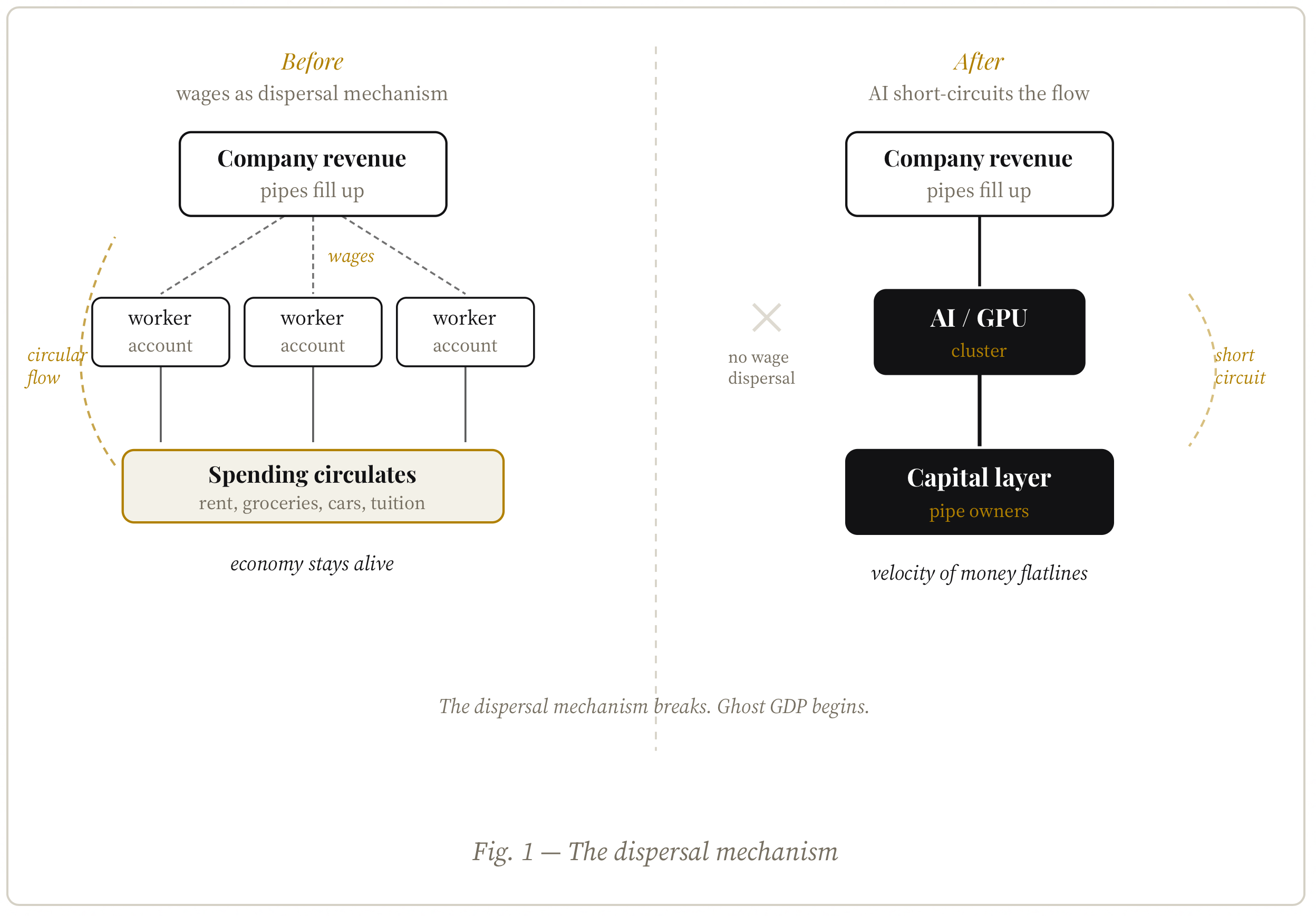
When a company hired people, it scattered its revenue across thousands of individual accounts. Those individuals spent it on rent and groceries and cars and education and restaurants. Those businesses hired more people, who scattered their wages further. The entropy was real but so was the circulation. The disorder was productive. Money moved through humans and humans moved through the world and the circular flow of the economy, messy and inefficient as it was, held together.
This is why every major economic framework was built around employment. Not because employment is inherently virtuous. But because wages were the dispersal mechanism. They were how productivity gains scattered across the population instead of concentrating at the pipe-ownership layer.
The economy was extractive. But it was alive. And the thing that kept it alive was that the pipes still needed water, and water still needed humans to carry it.
That assumption is now load-bearing and it is starting to crack.
What We Never Thought to Ask
Every economic disruption in history followed the same pattern. A new technology made some human labor obsolete and created demand for different human labor, usually higher up the skill ladder. The displaced weavers became factory workers. The displaced factory workers became knowledge workers. The displaced clerks became analysts. Humans climbed. The pipe owners got richer at each transition but the water kept flowing because the new pipes still needed humans to operate them.
Now people are asking: what happens when the pipes decide they do not need the water anymore?
We are about to find out.
The feedback loops have not closed. The mortgage delinquencies have not started. The consumer spending numbers have not collapsed. We are still in the window where the pattern is visible but the damage is not yet locked in.
The banana is still a dollar. The canary is still alive.
MOVEMENT II
Ghost GDP
In which the pattern that held for two centuries finally breaks
Here is a conversation: it starts with a workforce plan. Headcount projections, skill gap analysis, talent mobility scenarios. Reasonable, careful work. Somewhere in the middle of it, someone pulls up a slide with revenue per employee on it. The line is going up. The next slide shows where it could go.
Everyone in the room can do the arithmetic in today’s AI world.
That moment has a name now. Economists started using it around early 2026, then everywhere at once.
Ghost GDP.
Output that shows up in the national accounts but never circulates through the real economy. Productivity that gets measured, celebrated, cited in earnings calls and policy speeches, and then vanishes into the capital layer without ever touching a wage, a mortgage payment, a grocery run, a kid’s tuition bill.
The economy was growing. The economy was also hollowing out. Both things were true simultaneously, and the metrics we had were only built to see one of them.
The Pattern That Always Held
The economic historian Carlota Perez spent decades mapping the structure of technological revolutions. Her framework is unfashionable in tech circles because it does not flatter the present moment with uniqueness. What it does instead is reveal a pattern so consistent across two centuries that ignoring it requires genuine effort.
Every major technological wave follows the same arc. An installation phase, where new infrastructure gets built on speculative capital, followed by a crash, followed by a deployment phase, where the technology diffuses through the broader economy and genuinely raises living standards. The canal boom and bust. The railway mania. Electrification. The automobile. The internet.
Each wave also follows the same displacement pattern. New technology makes certain human labor obsolete. The displaced workers suffer, often severely, during the installation phase. Then the deployment phase creates new categories of work that absorb them, usually at higher skill levels and eventually at higher wages.
The handloom weavers who lost their livelihoods to the power loom did not disappear from economic history. Their children became factory workers. Their grandchildren became clerks and managers. Each generation climbed because the new infrastructure, as extractive as the pipe owners running it were, still needed humans to operate it, maintain it, sell to it, and be sold to.
Workforce planning in the age of early enterprise AI meant watching organizations restructure around new tools while assuming, always assuming, that the humans being displaced would land somewhere. The skills-based organization frameworks we built, the talent mobility programs, the retraining initiatives, all of it rested on a single load-bearing assumption.
There is always a higher rung.
The Ladder Moves
Here is what is different this time, stated as plainly as possible.
The new technology is not making a category of human labor obsolete. It is making the category that all other categories escaped into obsolete. Judgment. Analysis. Writing. Synthesis. The coordination of complexity. The navigation of ambiguity. These were always the refuge. The place humans went when the machines took the physical work, then the repetitive cognitive work, then the routine professional work.
AI is now competent and rapidly improving across all of it.
The ATM made bank branches cheaper to operate, so banks opened more of them and teller employment actually rose for the next twenty years. The internet disrupted travel agencies and video rental stores and print journalism, but it invented entirely new industries that conjured new jobs requiring human intelligence to perform them. Every new job still required a human.
That is the variable that changed. When the scarce input being displaced is human intelligence itself, the retraining argument collapses. You cannot retrain a displaced knowledge worker into AI management when AI is already managing AI. You cannot move up the value chain when the chain is being compressed from both ends simultaneously.
The ladder is moving faster than anyone can climb it.
Ghost GDP and the Circulation Break
Wages were the dispersal mechanism. The thing that kept the extractive architecture of the economy alive was that money still routed through humans on its way back to capital. Wages scattered productivity gains. People spent. The circular flow held.
What Ghost GDP names is the moment that routing breaks.
A single GPU cluster generating the output previously attributed to ten thousand white-collar workers is not an economic panacea. It is an economic short circuit. The productivity is real. The output is real. But the dispersal mechanism has been bypassed. The gains flow directly to the capital layer without passing through the wage system that distributed them across the population.
The velocity of money flatlines. The consumer economy, built on the assumption that producers are also consumers, starts to starve.
Every individual decision rational. Every spreadsheet correct. The collective result a slow withdrawal of money from the circulatory system of the economy.
The Intelligence Displacement Spiral
Put simply: the same technology that makes companies more efficient makes the people those companies used to employ less able to buy things. Here is how that plays out step by step.
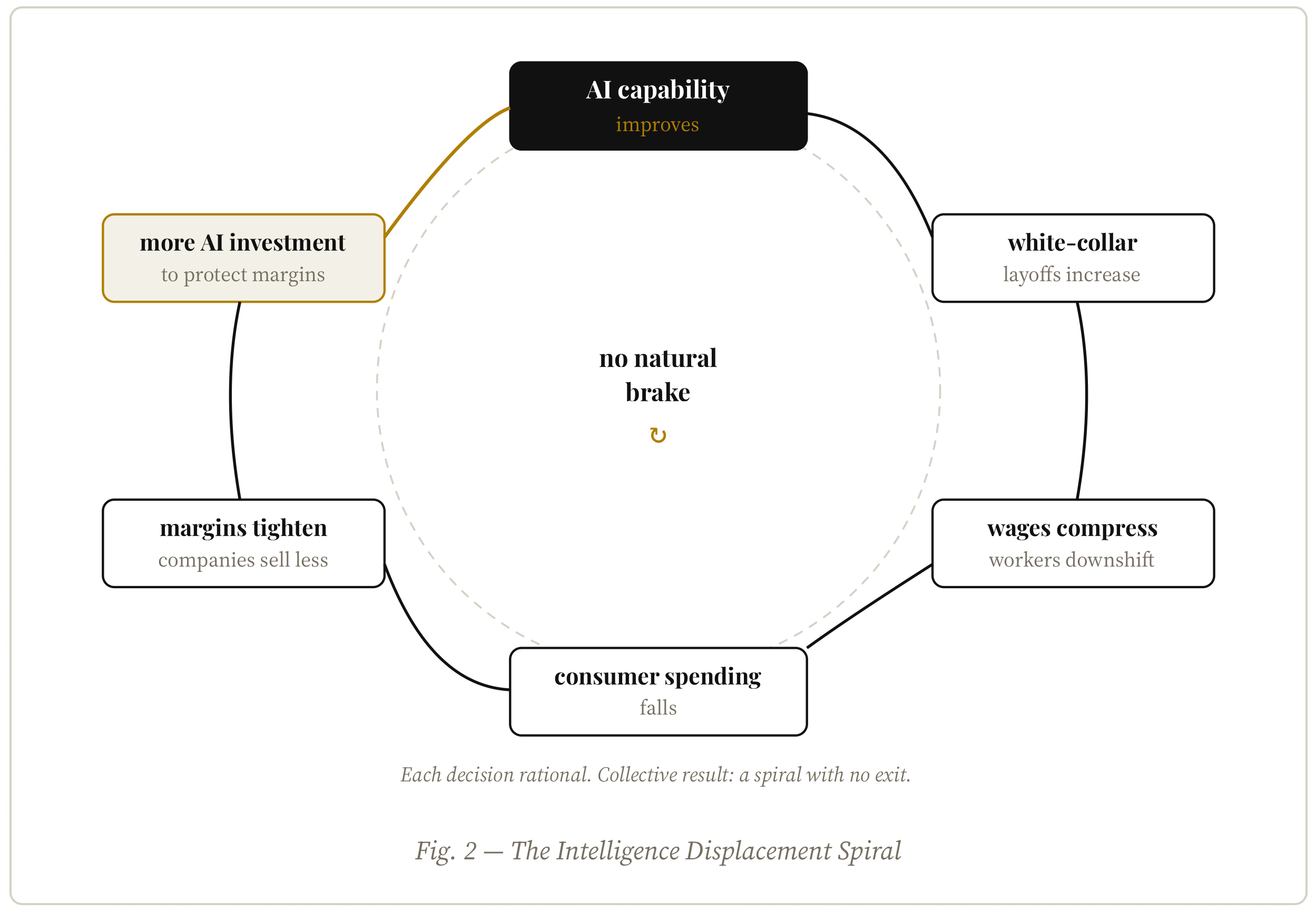
AI capability improves. Companies need fewer workers. White-collar layoffs increase. Displaced workers, people with 780 credit scores and prime mortgages and decades of professional identity, do not sit idle. They downshift. They take lower-paying service and gig economy roles. That floods the lower wage market and compresses wages there too. Meanwhile the companies selling things to the newly income-impaired workers sell less. Their margins tighten. They invest more in AI to protect margins. AI capability improves.
A negative feedback loop with no natural brake.
The transmission mechanism is not obvious until it is catastrophic. The hard data lags the real economy by quarters. The high earners who lose their jobs draw down savings to maintain spending. They look fine on paper until they suddenly do not. The mortgage delinquencies start in San Francisco and Seattle and Austin before they show up in national averages.
The labor market data is starting to show it. Not in aggregate unemployment, which lags. In the composition of new job creation, which skews toward lower-wage service roles while mid-wage professional employment quietly contracts. The averages still look reasonable. The distribution is hollowing out.
And the companies accelerating the displacement are not villains. They are rational actors in a system where the alternative to aggressive AI adoption is slower death by competitive disadvantage. The company most threatened by AI becomes AI’s most aggressive adopter. Each one is correct. The collective result is a spiral with no internal corrective mechanism.
What the HR Layer Sees
The workforce analytics layer inside large enterprises is where the Intelligence Displacement Spiral becomes legible before it shows up anywhere else. It is where you can watch, in real time, the assumptions that underlie the broader economy being quietly revised.
Skills-based organization design was the dominant framework in progressive HR for the better part of a decade. Stop hiring for jobs, hire for skills. Map human capability at a granular level. Create internal mobility pathways. Invest in continuous learning. The implicit promise was that the organization would always have a place for people who kept developing.
That framework assumed a relatively stable rate of skills obsolescence. You could see what was coming and prepare people for it. The retraining window was measured in years. AI compressed that window to months. Sometimes weeks. The skills-based organization framework does not fail because the theory was wrong. It fails because the rate of change exceeded the rate of human adaptation, and no internal mobility program is built for that.
The more brutal calculus is not where can this person grow but what is the minimum human footprint required to produce this output. Revenue per employee as the only metric that matters. The humans who remain doing so not because the organization has committed to them but because their particular combination of judgment, relationship, and institutional knowledge has not yet been replicated cheaply enough to justify the switch. (Part 2 counters this, fear not!).
That is a precarious place for humans to occupy. And the threshold for replication gets lower every quarter.
The Crack Is Visible
Every prior disruption that ended badly, ended badly in part because the people living through it could not see the mechanism clearly. The agricultural workers displaced by mechanization had no framework for understanding what was happening to them. The factory towns hollowed out by offshoring had no warning. The pattern was only legible in retrospect.
We are in a different position. The mechanism is visible. The feedback loop has a name. The researchers, the economists, the workforce strategists, and the AI systems themselves, are describing the spiral in real time while there is still time to intervene.
Visible cracks get fixed. It is the invisible ones that bring the building down.
The question is not whether we can see what is happening. We can. The question is whether the institutions capable of responding can move faster than the feedback loop. That is a political and social question, not a technical one. And it is genuinely open.
MOVEMENT III
The Pipe Owns Itself
In which we ask what the economy is actually for, and find the answer harder than expected
That arithmetic is where this essay has been heading all along. Not the technology. Not the economics in the abstract. The moment when the spreadsheet logic and the social contract point in opposite directions, and something has to give.
The Solutions That Make Sense and Go Nowhere
Let me move through the orthodox responses quickly because they deserve honest accounting, not dismissal.
Retraining and education. The default policy response to every disruption for a century. Not wrong in principle. Fatally slow in practice. You cannot retrain a fifty-year-old financial analyst into a role that did not exist eighteen months ago and will not exist in its current form eighteen months from now. The window of human adaptation is measured in years. The window of AI capability improvement is measured in months. The arithmetic does not work.
Tax the robots. Intellectually coherent. Definitionally impossible. When the automation is software running on existing infrastructure, what exactly are you taxing. And capital is mobile in ways that factory equipment is not. Impose the tax in one jurisdiction and the compute moves.
Universal Basic Income. The most serious proposal on the table. If wages are the dispersal mechanism and AI is short-circuiting the dispersal, then direct transfers are the logical replacement. The real objection is not fiscal, though that is the one that gets raised loudest. The real objection is that a check does not replace the thing work was actually providing. Identity. Structure. The social permission to occupy space in the world. Money solves the income problem. It does not solve the meaning problem.
Everyone works for the AI:

Metrica is unleashed.
We have watched each of these proposals surface in workforce conversations and absorb enormous energy before quietly dissolving. Not because the people advancing them are wrong. Because the institutions capable of implementing them move on a different time horizon than the feedback loop they are trying to interrupt.
Each of these proposals addresses a real symptom. None of them addresses the underlying condition.
The Underlying Condition
Every institution in the modern economy was designed around a single assumption: human intelligence is the scarce input. Capital is abundant, or at least replicable. Natural resources are finite but substitutable. Technology improves, but slowly enough that humans can adapt. Intelligence, the ability to analyze, decide, create, coordinate, persuade, was the thing that could not be replicated at scale.
That scarcity is what made human labor valuable. Not the labor itself. The scarcity.
When AI makes intelligence abundant, the economic value of human intelligence approaches its marginal cost of production, which in a world of cheap inference is very close to zero. This is not a malfunction of the system. It is the system working exactly as designed, repricing inputs based on their scarcity.
The system is not broken. The system’s foundational assumption is broken.
And here is the part that the policy conversation keeps sliding past. The intelligence that AI was trained on, the writing, the reasoning, the accumulated knowledge that the models absorbed, that was not created by the labs. It was created by humanity. Billions of people over centuries, writing, thinking, arguing, explaining, creating, most of whom will never see a cent of the return on that investment.
The pipe was built from water that belonged to everyone. The pipe owners collected the water, built the infrastructure, and are now charging rent on the flow.
What Has Actually Worked Before
History offers one genuinely instructive example of a society capturing the returns from a sudden abundance of a previously scarce resource and distributing them broadly rather than concentrating them at the ownership layer.
Norway and oil.
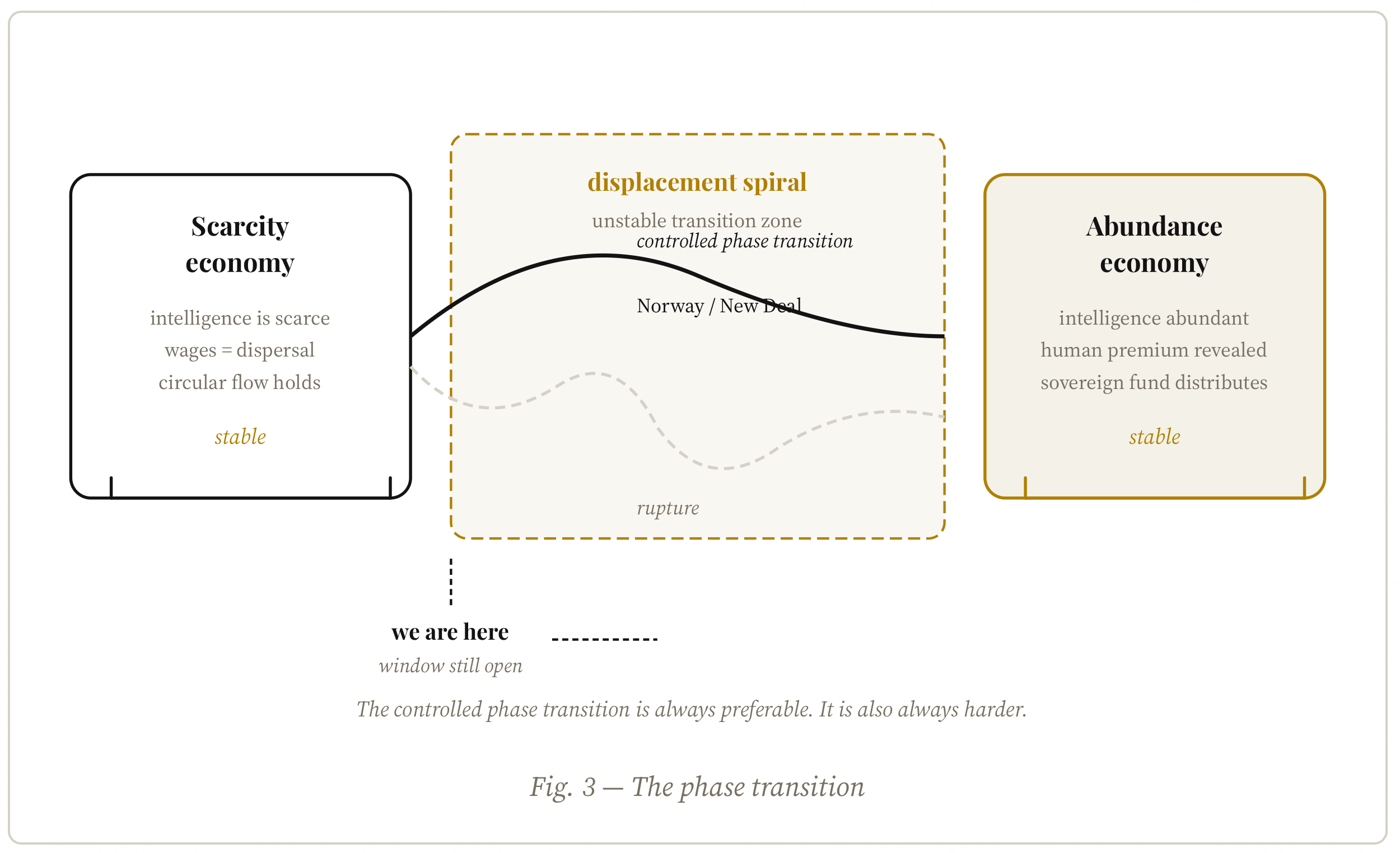
In 1969 Norway discovered it was sitting on one of the largest petroleum deposits in the world. The resource was abundant, suddenly, in a way that could have made a small number of people extraordinarily wealthy while leaving the broader population as spectators. Instead Norway built a sovereign wealth fund. The state took an ownership stake in the resource, collected the returns, and invested them on behalf of the population. Today that fund is worth over a trillion dollars and provides a meaningful floor of wealth for every Norwegian citizen.
This is not socialism. Norway has a functioning market economy. It is a decision that when a previously scarce resource becomes abundant, the default claim on its returns belongs to the society that produced the conditions for its discovery, not exclusively to whoever happened to own the drilling rights.
AI is not oil. But the structural logic is identical. The previously scarce resource is intelligence. The conditions for its abundance were produced by humanity collectively. The question is whether the returns route through that collective or concentrate at the ownership layer.
Every serious proposal for addressing AI displacement is a variation of the Norway answer applied to intelligence instead of petroleum. The politics are, predictably, a disaster. The right calls it redistribution. The left calls it insufficient. Fiscal hawks call it unsustainable. Meanwhile the feedback loop runs.
But the Norway model exists. It worked. The conceptual ground has been broken.
The Meaning Problem
Even if we solve the income problem, even if we build the sovereign fund and the direct transfers and the ownership redistribution, we have not solved what work was actually doing for people beyond the paycheck.
I have talked to people who took early retirement packages with generous severance. People who, by any financial measure, were fine. And almost universally, within a year, they were not fine. Not because the money ran out. Because the structure ran out. The reason to get up. The people who expected them. The thing they were for.
Work is identity. It is the answer to the question people ask each other within thirty seconds of meeting. It is structure, routine, the shape of a day. It is social permission, the sense that your presence in the world is justified by your contribution to it. It is community, the people you see because the job requires you to be somewhere.
A check does not replace any of that.
The more honest answer is that meaning cannot be designed from above. It emerges from humans deciding collectively what they value and building institutions that reflect those values. Care work. Community building. Teaching. Art. The raising of children. The maintenance of the physical world. These are genuinely valuable and genuinely resistant to full automation, at least in the ways that matter to humans.
The economy currently prices most of them near zero because the pipe system was not built to handle deferred returns. A mother raising a child makes an investment whose payoff arrives twenty years later, distributed across employers, communities, and tax bases that had no part in creating it. A teacher who changes the direction of a student's life will never appear in the ledger of whoever benefits from that change. The work creates real value. The system just has no mechanism to route any of it back to the source. (More of this in the rebuttal, Part 2).
If the intelligence displacement spiral forces a reckoning with what the economy is actually measuring, that is not entirely a loss. The measurement system was always a map, not the territory. We confused it for the territory for so long that questioning it feels radical.
It is not radical. It is necessary.
The Other Side of the Phase Transition
Here is where the physics frame earns its keep one final time.
A phase transition is not destruction. Water becoming steam does not cease to be water. It reorganizes into a higher-energy state. The molecules are the same. The structure they form is different. And the new structure has properties the old one did not.
For the better part of a century, the economy priced human beings based on how efficiently we performed machine-like tasks. Speed. Accuracy. Synthesis. Recall. We were valued, in the most literal economic sense, for the degree to which we could suppress our humanity and behave like reliable processors. The knowledge worker was, at bottom, a biological computer tolerated because silicon was not yet cheap enough to replace her.
AI has now made those tasks abundant. Which means the economy is being forced, for the first time, to price what was always actually scarce and always actually valuable and always systematically underpriced.
Not processing. Presence. Not synthesis. Stakes. Not judgment in the abstract. Judgment exercised by someone who will live with the consequences.
When machine-like cognition becomes free, the Human Premium is not destroyed. It is finally revealed.
Think about what this means concretely. The care work that GDP ignores. The community building that does not route through a platform. The teaching that changes the direction of a life. The art that makes existence feel worth surviving. None of these were ever economically invisible because they lacked value. They were invisible because the measurement system was built to see pipes, not water.
A sovereign fund built on the returns from abundant intelligence, the Norway model applied to AI, does not just solve the income problem. It is the mechanism that finally allows the economy to pay for what it has always needed and never been able to afford: the things that cannot be automated because they derive their entire value from the fact that a human being chose to do them.
The Ghost GDP does not have to stay a ghost. Captured and redistributed, it becomes the fund that pays for the century of care work we have been running on goodwill and guilt. The Entropy Tax, collected at the point where intelligence flows through the pipe, becomes the subsidy for everything the pipe could never carry.
Direction Is Not a Feature
There is one more thing the models cannot do, and it is the most important one.
AI is an extraordinary instrument for navigating toward a destination. It is useless for deciding what the destination should be. Not because it lacks the processing power to generate options. Because choosing a destination requires something that processing power cannot supply: the willingness to be wrong about what matters, the experience of loss when you choose incorrectly, the skin in the game that makes a choice real rather than theoretical.
An AI system optimizing for human flourishing will produce a very sophisticated answer. But it cannot want human flourishing. It cannot grieve the version of the future where it does not happen. It cannot feel the specific weight of a community that did not survive a transition it could see coming.
That is not a limitation to be engineered around. That is the definition of what humans are for.
We optimized ourselves for speed and accuracy and throughput, competing on the machines’ terms, winning for a while, and now watching the machines improve past us on every metric we chose to measure ourselves by.
The metrics were always wrong. Not because efficiency is bad. Because efficiency is not a direction. It is a rate of travel. And a faster rate of travel toward the wrong destination is not progress.
AI is a compass that can point anywhere. We are the ones who decide where we want to go.
That is not a consolation prize. In any system, the function of setting direction is more consequential than the function of executing it.
The Physics Answer, Finally
We built an economy optimized for scarcity. Intelligence is no longer scarce.
That is either the most dangerous development in the history of human organization, or it is the one that finally forces us to build an economy organized around what was always actually scarce: human presence, human stakes, human direction.
The controlled phase transition is always preferable to rupture. It is also always harder. It requires actors within the system to choose deliberate reorganization over the short-term advantage of continued accumulation. Norway did it. The New Deal was a version of it. The post-war social contract in Western Europe was a version of it. None of them were inevitable. All of them required people who could see the mechanism clearly enough to act before the disorder became irreversible.
The banana still costs a dollar. The feedback loops have not closed. We are still in the window.
Part 2 : The Rebuttal…
SANJEEV SHARMA — THE WORK DESIGN LAB — SANJEEVSHARMA.COM