
The Keyhole
Skills decay. The drive to understand doesn't.

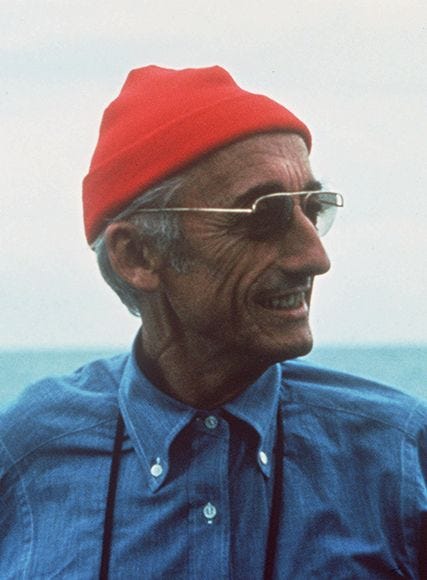
In 2019, I gave a presentation on Tableau to a group that was new to it, though I had been using it for years. I could have started with the dashboard, the numbers, the filters.
Instead, I put up a photograph of the deep ocean.
Beneath it, a quote from Jacques Cousteau:
What is a scientist after all? It is a curious man looking through a keyhole, the keyhole of nature, trying to know what’s going on.
The point had nothing to do with the tool. It was about what you bring to the room before you open a dashboard. Without that drive to understand, the chart is decoration. You see the number, note it, move on. But someone genuinely compelled to understand it asks why. Then asks why again. Then follows the thread somewhere nobody expected to go, and that is where the insight lives.
You might sound foolish at first. You will ask the obvious question, the one everyone else pretended not to need answered. That is the price of eventually becoming the person who actually understands what is happening.
That was 2019. I had no idea how much I would need that framing seven years later.
---
We talk now about the half-life of skills. The things you spent years learning are expiring faster than you can replace them. Technical skills, domain expertise, certain kinds of judgment. The shelf life on any specific capability is compressing toward something that can feel, on a bad day, like futility.
The instinct is to run faster. Learn the new tool. Master the new framework before it is itself obsolete. The logic is understandable. It is also wrong.
Not wrong in the sense that skills do not matter. They do. But wrong in diagnosing the root cause. The problem is not which skills you have. The problem is whether you have the one disposition that generates new skills as the old ones expire.
That disposition is curiosity.
---
I want to be careful about how I use the word, because it gets flattened. In professional settings it often means something like “willing to learn.” A pleasant trait on a performance review.
That is not what I mean.
What I mean is closer to an affliction. The inability to let a thing go unexplained. The compulsion to follow a thread past the point where it is comfortable. The asking of the second question, and the third, even when the room has moved on.
That is the spark. What separates the real thing is what happens after: the return. Two days later, still pulling on it. Two weeks later, still not done.
I saw this once in a way I have not forgotten.
It was 2014, a coffee shop in San Francisco. A well-known tech executive, someone who had run one of the most culturally significant companies of that era, walked over unprompted and started asking about my wife’s work. Within minutes he had entirely redirected his attention to a translation application she was using, one that paired legal documents across languages. Today it sounds obvious. In 2014 it hadn’t really been done.
He had every reason to be the most interesting person in any room. He chose instead to be the most interested.
Two weeks later, he sought me out again. He had kept pulling on the thread. He wanted to say how struck he had been, not as a pleasantry, but as someone who had gone home and kept thinking about it. Nobody required that. That is what the real thing looks like.
---
There is a structural reason this disposition endures when others do not.
Skills are answers. The drive to question is the process that generates them. When answers expire, skills expire with them. But the process doesn’t. Someone genuinely wired this way, in a field that no longer exists, will find the adjacent field almost automatically. Not because they are lucky, but because they have spent their career practicing the one thing that transfers: the refusal to accept the surface.
This is why it compounds in a way that expertise often does not. Deep expertise in a stable domain is valuable. In an unstable environment, deep expertise in the wrong thing becomes a liability before it becomes an asset. The questioning disposition doesn’t have that problem. It is not pointed at any one domain. It is pointed at whatever is real.
---
Isn’t everyone curious? Don’t most people think of themselves that way?
Yes. Behavior does not support the self-report.
The real thing is visible in conduct. It looks like asking the question you are afraid sounds dumb. Following an idea into a domain you have no credential in, because the idea went there and you had to go with it. Being genuinely pleased when something doesn’t work as expected, because now you have a puzzle instead of a confirmation.
Most professional environments are structured, intentionally or not, to suppress this. Speed rewards the familiar answer. Meetings reward confident certainty. Performance reviews reward outcomes, not questions. The instinct gets quiet. Not because people lose it, but because the incentives chip away at the behavior until only the self-description remains.
The people who resist this are not more talented. They are more stubborn about one specific thing.
---
AI will compress the value of information retrieval, pattern matching, and template application. That is a significant fraction of professional cognitive work. Anyone whose value is primarily in knowing things, rather than doing something generative with what they know, is already in a difficult position.
But this is not an information advantage. It is a processing advantage. The person who has it is not distinguished by having more data. They are distinguished by what they do with whatever they encounter: interrogating it, connecting it, following it somewhere. That process does not become less valuable as AI gets better. It becomes more valuable, because the surface area of what can be interrogated and followed expands continuously, and the people who will navigate that expansion are the ones who genuinely want to.
---
I did not fully understand, in 2019, why I put that slide up first. I knew it felt right. I knew I was trying to teach a posture, not a feature set.
The ocean in that photograph was not decorative. It was the point. We are all looking through the keyhole. The question is who keeps looking, and who walks away.
After years of watching analysts, executives, scientists, and builders, I have come to think the difference has very little to do with intelligence, credentials, or experience.
It has to do with who cannot quite bring themselves to stop.

sanjeevsharma.com