
What Bottlenecks Know
Before you clear it, ask what it knew.


When people experience friction, they assume something has gone wrong. This is nearly universal. Psychologists call it the fluency heuristic: the easier something feels to process, the truer and better it seems. Friction feels like failure. Smoothness feels like competence. This bias is baked deep, and it shapes how organizations respond to every approval queue, every compliance review, every hand-off that adds a day to a process. The response is almost always the same: remove it.
Here is a question that bias makes very hard to ask seriously: what if the bottlenecks are the point?
Not the individual bottleneck. Not the particular permit office or HR approval queue or compliance review that slows your specific process down. The structural fact of bottlenecks. The way every functioning economy, every large organization, every complex system organizes itself around points of constraint. Those constraints are not failures of design. They are features of it. They encode something. And when AI removes them at scale, what gets lost is not just the delay. It is the information the delay was carrying.
Consider what it costs to build a supportive housing unit in Los Angeles or San Francisco. The number has climbed past $800,000 per unit. The stated goal of the program is to house people who cannot afford housing. The math has inverted. The mechanism designed to solve the problem now costs more than the market it was meant to correct.
The standard read is that this is inefficiency. Bureaucratic bloat. Broken government. That read is wrong, or at least incomplete. What the $800,000 unit actually represents is a precise accounting of how many accountability surfaces exist in that process. Environmental review. Neighborhood input periods. Permitting layers. Union labor requirements. ADA compliance. Financing structures. Each layer serves a constituency. Each one extracted a cost in exchange for clearing a gate. Together they produced a number that defeats the purpose. But each one, in isolation, was doing something. Encoding a value. Holding an accountability. Saying: this step matters enough to require a checkpoint.
Remove all of them in the name of speed and you do not build housing faster. You build housing without knowing where the system is breaking. The sensors are gone. The readout goes dark.

The Signal Inside the Friction
A bottleneck is not just a delay. It is a directional signal with a magnitude attached.
Direction is simple. Things go up, down, or stay flat. Attrition rising. Throughput falling. Headcount holding steady. The direction alone tells you what kind of response is required. You already know what to do when something goes up that should go down, or falls when it should hold. That knowledge is tacit and nearly universal. No organization needs a consultant to tell them that rising attrition in a key engineering cohort requires a response.
What analytics actually provides is the magnitude. How fast is attrition rising. By how much. In which specific cohort. Over what time window. The direction is the call to action. The magnitude is the calibration of effort. A 2% increase in voluntary attrition among mid-tenure engineers is a monitoring item. A 14% increase in the same cohort over 90 days is an emergency. Same direction. The direction tells you something is wrong. The magnitude tells you what kind of wrong it is. It changes how much of yourself you commit to doing it.
This is the function bottlenecks serve in organizational systems. They are not primarily about slowing throughput. They are about generating magnitude data. The depth of the queue at a given checkpoint is a live readout of how stressed that part of the system is. The length of a compliance review signals how much complexity is being compressed into that step. The time-to-fill metric on an open role is not an HR performance indicator. It is a signal about whether the organization can convert demand into capacity at the rate the market requires. Each constraint is a sensor. The constraint and the measurement are the same thing.
The bottleneck is not the problem. The bottleneck is the instrument that tells you where the problem lives and how serious it is.
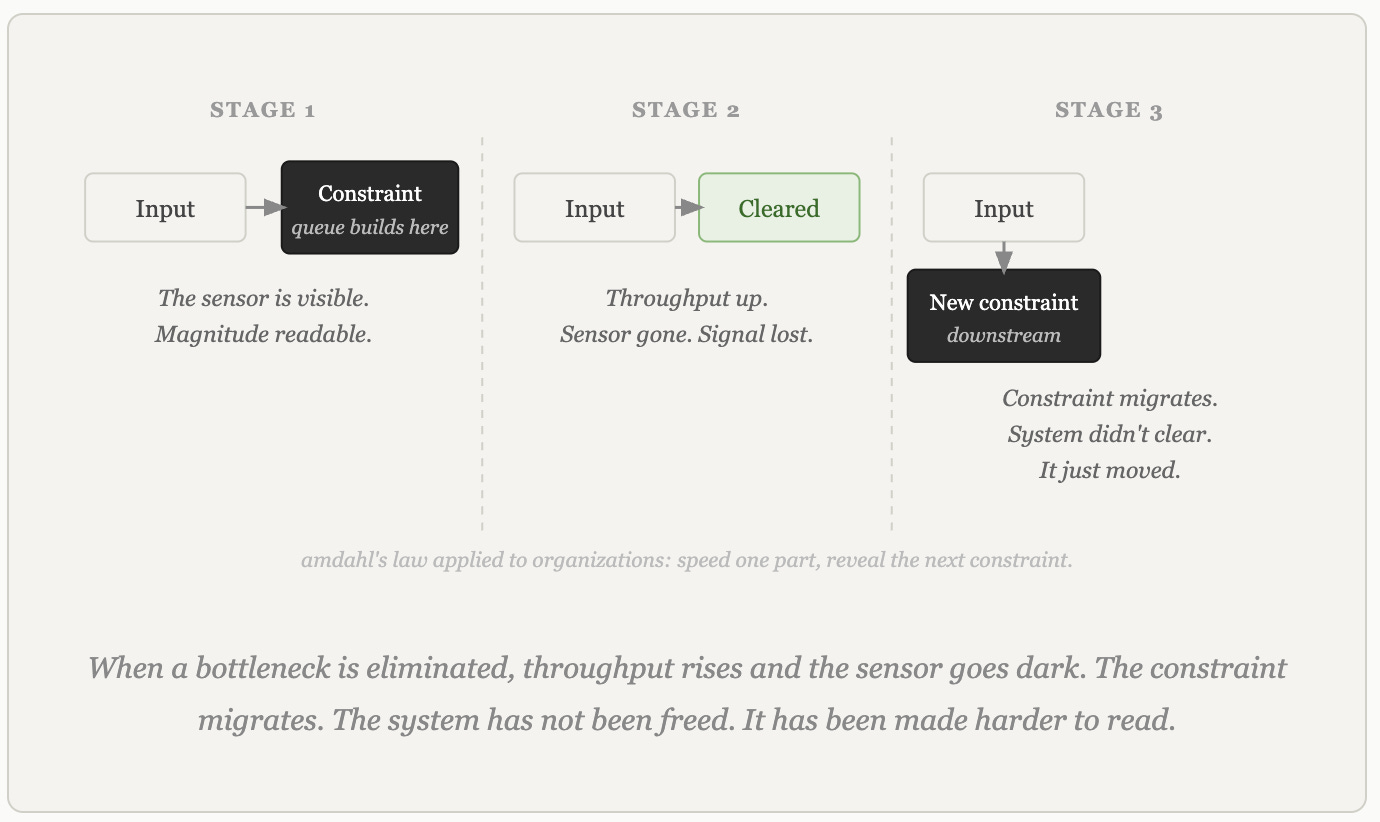
When you eliminate a bottleneck, you get throughput. You also lose the readout. The instrument goes dark. Work moves faster through a section of the system you can no longer see.
What Anthropic Just Learned
The most AI-accelerated organization on earth just published a detailed accounting of what happens when you remove bottlenecks at unprecedented speed. The fact that it is also the organization building the tools doing the removing is what makes the data unusually honest. This is not a vendor case study. It is a company documenting its own structural transformation in real time, including the parts that did not go as planned.
The headline numbers are striking. Engineers are shipping eight times as much code per quarter as they were two years ago. More than 80 percent of the code merged into production was written by Claude. A task that would have taken a skilled human four years of painstaking work was completed in weeks. These are not marginal efficiency gains. They are a different mode of operation.
But the more instructive part of the document is what happens next. Anthropic accelerated the engineering function substantially. Then they discovered something every system produces when you speed up one part of it: the constraint migrated. Human code review became the new bottleneck. The queue simply moved downstream. They name this directly, citing Amdahl’s law, which states that the speed of any process is capped by its slowest component. Clear one constraint and you have not cleared the system. You have revealed the next one.
They go further. As the volume of AI-generated ideas, initiatives, tools, and simulations exploded, a new constraint emerged: the organizational capacity to evaluate and prioritize them. There was more signal than the system could process. And their conclusion, stated plainly, is that the ability to identify and clear these migrating bottlenecks may be the most important skill any organization can develop.
That is a navigation story. The bottlenecks did not go away. They moved.
The Work That Was Always There
Most Fortune 500 organizations run on a specific pattern. Work arrives. It enters a queue. Someone approves it, reviews it, enriches it, or routes it. The work exits the queue and enters the next one. This is not an accident of poor management. It is a design. The queue is where accountability lives. The person in the queue is not only processing the work. They are reading it. They are the sensor for whether the work is correctly specified, whether the volume is appropriate, whether the downstream system can absorb what the upstream system is producing.
Remove the person from the queue and the work moves faster. The accountability surface also disappears. The two functions were bundled. Nobody designed them as separate things, which is why most AI deployment plans do not separately account for them. The throughput gain is visible and measurable. The loss of the sensing function is not. It shows up later, in a different form, attributed to a different cause. A name for this pattern: call it substitution. We replace the thing we can see and measure with the thing we cannot, without noticing the swap.
This is what happens in the HR case. Organizations moving to eliminate HR approval steps, reduce headcount review cycles, and automate compliance workflows are making a real and sometimes correct bet that the throughput cost is too high. Six weeks to process a regulatory change is genuinely indefensible when the system can do it in two hours. That is the right call. But the compliance reviewer was also doing something besides slowing things down. She was watching the edge cases. She was the person who knew what went wrong the last time a similar regulation came through, because she was the one who had to clean it up. That knowledge does not transfer to the system automatically. It dissipates.
Eliminating the bottleneck is the easy part. The hard part is figuring out what the bottleneck knew.

Direction and Magnitude
The direction/magnitude frame is simple. What is less obvious is where organizations have always been getting that magnitude data without knowing it.
Direction is almost never the problem. When attrition is rising, leaders know they need to respond. When a key product metric is falling, the direction of required action is legible. When a hiring pipeline is slowing, the needed move is not mysterious. Experienced leaders carry directional intuition as tacit knowledge. They developed it over years of watching systems respond to pressure. They do not need a dashboard to tell them which way is up.
What they need is magnitude. How far is it going, and how fast. That is the calibration that determines response intensity. A 3% shift in the wrong direction on a stable metric is a monitoring item. A 3% shift per month compounding for a quarter is a structural problem. The direction is identical. The required response is not. The analytics layer exists to supply this calibration. Its job is not to tell decision-makers what to do. They already know. Its job is to tell them how much.
Economists have understood this about price signals for over a century. A price is not primarily information about value. It is information about scarcity and pressure. When the price of something rises sharply, you do not need an economist to tell you that demand is outpacing supply. You already know the direction. The price tells you the magnitude. It tells you whether to tweak at the margin or restructure entirely. Bottlenecks are the organizational equivalent of price signals. The depth of a queue tells you how much pressure is building at that point. The time something spends waiting for approval signals how much complexity is being compressed into that step. Strip out the bottleneck and you get the organizational equivalent of price controls: things appear to move freely right up until the underlying pressure surfaces somewhere else, suddenly, in a form nobody predicted.
None of this requires a sophisticated analytics stack. It requires someone paying attention to the sensor. When the sensor is removed, the data stops. The directional intuition is still there. The calibration is not.
Analytics does not tell you what to do. It tells you how much to do. The bottleneck was always generating that data. Most organizations just called it delay.

The Recursive Problem
Anthropic’s document raises a second-order version of this issue that deserves direct attention. The recursive self-improvement thesis is, at its core, a bottleneck thesis. The question of whether AI can improve AI is a question about which constraints remain irreducibly human. Right now, the answer is: the judgment calls. Which experiments to run. Which results to trust. Which problems are worth working on at all. These are the bottlenecks that have not yet cleared.
The document is careful about what happens if they do clear. If AI systems become capable of direction-setting as well as execution, the human role narrows to oversight, validation, and verification. The bottleneck migrates again, this time to the governance layer. Someone still has to decide what the system is optimizing for. Someone still has to adjudicate when it goes wrong. The constraint does not disappear. It becomes the only thing left that matters.***
For most organizations, recursive self-improvement is not the near-term question. The near-term question is more mundane and more immediately consequential: as AI clears the operational bottlenecks, what replaces the sensing function those bottlenecks were performing? What reads the magnitude now? The signal does not vanish because the checkpoint did. It becomes harder to find.
Anthropic’s answer, tentative and worth watching, is that bottleneck navigation becomes the core organizational competency. The ability to spot where the constraint migrated. The ability to build sensing back into the system at the new location. The ability to read magnitude when the instrument is no longer a human in a queue.
That is a different skill than the one most organizations have been developing. The last decade was an exercise in removing friction. The next one is an exercise in understanding what the friction was measuring.
What Remains
The economy does not run on bottlenecks because we failed to design better systems. It runs on bottlenecks because accountability requires checkpoints, and checkpoints create queues, and queues are the most legible form of magnitude data that most organizations have ever produced. Every industry that appears overrun with them, construction, healthcare, government permitting, enterprise HR, is also an industry with a dense accountability surface and a long history of things going badly wrong when that surface was thin.
AI is going to clear a great many of these. Some of them should be cleared. Economists distinguish between productive friction, extractive friction, and structural floors. Productive friction does real work: it encodes accountability, surfaces stress, distributes decision rights to the people with the most relevant information. Extractive friction does none of that. It exists to protect incumbents, inflate costs, and make entry expensive. A structural floor is different from both. Land in San Francisco does not get cheaper because the permitting process gets faster. Seismic requirements do not compress because AI reviews the drawings. Union labor rates in dense urban markets are not a bottleneck. They are a fixed input. The $800,000 housing unit contains all three. The structural floor is real and AI will not move it. But the gap between that floor and the observed cost is where compounding friction lives, and that gap is also real. The environmental review that catches structural risk is productive. The 18-month neighborhood input period that lets organized opposition slow projects indefinitely is extractive. The intervention requires distinguishing between them, not eliminating them wholesale.
But the clearing operation does not come with an automatic replacement for the sensing function. That has to be designed separately, deliberately, and in advance of the clearing. Organizations that do not do this work will find themselves moving faster through processes they can no longer read. The constraint will migrate and they will not see it until it surfaces as a crisis in a part of the system nobody was watching.
The $800,000 housing unit is not an argument against streamlining permitting. It is an argument for understanding which of those approval layers was encoding something real before removing it. The answer is not all of them. It is also not none of them.
The bottleneck knew something. The question worth asking, before you clear it, is what.
***For an unexpectedly precise illustration of what removing every human checkpoint from a high-stakes system actually produces, start here: youtu.be/qxW0yGvWRTk?t=24

The Work Design Lab explores the structural forces reshaping how organizations work, measure, and decide. Views are my own and do not reflect the strategy or opinions of my employer.